
NURS 6051 Week 9 Mind Map Psychological Disorders
Mind Map Psychological Disorders
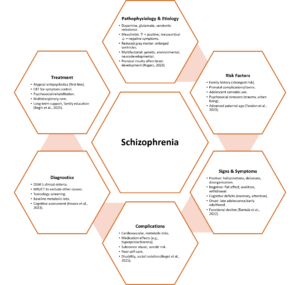
Schizophrenia is a serious and long-standing mental health disorder that impacts an individual’s ability to process thoughts, understand emotions, interpret their environment, and act socially (Rogers, 2023). Their ability to accurately perceive and live in the real world will be significantly hindered. The mind map below is an overview of schizophrenia (pathophysiology, etiology, risk factors, clinical signs/symptoms, diagnostic evaluation, and treatment options) and highlights important information to be aware of concerning schizophrenia.
Mind Map: Schizophrenia
Conclusion
Schizophrenia is an intricate mental health condition that has both physiological and psychosocial elements. Recognizing the underlying physiology and understanding what causes it – along with identifying its associated symptoms – are important for developing a correct diagnosis and providing effective treatment solutions. Schizophrenia interventions and comprehensive approaches to delivering care through multi-disciplinary teams have been proven to increase overall patient satisfaction while decreasing complications associated with this illness; thereby improving patient quality of life.
References
Begni, V., Marchesin, A., & Riva, M. A. (2025). IUPHAR review – Novel therapeutic targets for schizophrenia treatment: A translational perspective. Pharmacological Research, 214, 107690. https://doi.org/10.1016/j.phrs.2025.107690
Howes, O. D., Bukala, B. R., & Beck, K. (2023). Schizophrenia: from neurochemistry to circuits, symptoms, and treatments. Nature Reviews Neurology, 20(1), 22–35. https://doi.org/10.1038/s41582-023-00904-0
Rantala, M. J., Luoto, S., Borráz-León, J. I., & Krams, I. (2022). Schizophrenia: The new etiological synthesis. Neuroscience & Biobehavioral Reviews, 142, 104894. https://doi.org/10.1016/j.neubiorev.2022.104894
Rogers, J. (2023). McCance & Huether’s pathophysiology: The biologic basis for disease in adults and children. (9th ed., pp. 1153–1190). Elsevier.
Tandon, R., Nasrallah, H., Akbarian, S., Carpenter, W. T., DeLisi, L. E., Gaebel, W., Green, M. F., Gur, R. E., Heckers, S., Kane, J. M., Malaspina, D., Meyer-Lindenberg, A., Murray, R., Owen, M., Smoller, J. W., Yassin, W., & Keshavan, M. (2023). The schizophrenia syndrome, circa 2024: What we know and how that informs its nature. Schizophrenia Research, 264, 1–28. https://doi.org/10.1016/j.schres.2023.11.015
CLICK HERE TO ORDER A PLAGIARISM-FREE PAPER
Mind map on Schizophrenia
- Follow the rubric carefully and address all required sections.
- Make sure
- File opens correctly
- Text is clear and readable
Classroom Resources:
- Rogers, J. (2023). McCance & Huether’s pathophysiology (9th ed.). Elsevier – Evolve.
- Chapter 19: Neurobiology of Schizophrenia, Mood Disorders, Anxiety Disorders, Posttraumatic Stress Disorder, and Obsessive-Compulsive Disorder
- McIntyre, R. S. & Calabrese, J. R. (2019). Bipolar depression: The clinical characteristics and unmet needs of a complex disorderLinks to an external site.. Current Medical Research and Opinion, 1–14. doi:10.1080/03007995.2019.1636017. Retrieved from https://www.tandfonline.com/doi/full/10.1080/03007995.2019.1636017
Credit Line: Bipolar depression: The clinical characteristics and unmet needs of a complex disorder by McIntyre, R. S. & Calabrese, J. R., in Current Medical Research and Opinion. Copyright 2019 by Librapharm Ltd. Reprinted by permission of Librapharm Ltd via the Copyright Clearance Center.
NURS_6501_Week 3, 7, 9_Mind Map Assignment_Rubric
| NURS_6501_Week 3, 7, 9_Mind Map Assignment_Rubric | ||
| Criteria | Ratings | Pts |
| This criterion is linked to a Learning OutcomeSelect one of the possible topics provided and complete the MindMap.
Describe the Pathophysiology and Etiology of the primary diagnosis. List risk factors related to the primary diagnosis. |
30 to >27.0 ptsExcellentA thoroughly completed MindMap with a selected topic was submitted. The response accurately and thoroughly describes in detail the pathophysiology at the cellular level and shows understanding of the primary diagnosis. The response accurately and thoroughly identifies etiology for the diagnosis and lists appropriate risk factors.
27 to >23.0 ptsGoodA completed MindMap with a selected topic was submitted. The response describes the pathophysiology at the organ level of the primary diagnosis. The response does not identify specific etiology for the diagnosis and some risk factors are not linked to diagnosis. 23 to >19.0 ptsFairAn inaccurately complete or vague MindMap with a selected topic was submitted. The response inaccurately or vaguely describes the pathophysiology of the primary diagnosis. The response inaccurately or vaguely identifies etiology for the diagnosis and all risk factors are not linked to diagnosis. 19 to >0 ptsPoorAn incomplete MindMap with a selected topic was submitted, or is missing. The response does not describe the pathophysiology of the primary diagnosis. The response does not identify etiology for this diagnosis and risk factors are missing. |
30 pts |
| This criterion is linked to a Learning OutcomeWhat are the patient’s signs and symptoms for this diagnosis? How does the diagnosis impact other body systems and what are the possible complications? | 20 to >17.0 ptsExcellentThe response accurately and thoroughly describes in detail the patient’s signs and symptoms for this diagnosis. The response accurately and thoroughly describes in detail how this diagnosis might impact other body systems and their possible complications.
17 to >14.0 ptsGoodThe response accurately describes the patient’s signs and symptoms for this diagnosis. The response accurately describes how this diagnosis might impact other body systems and their possible complications. 14 to >12.0 ptsFairThe response inaccurately or vaguely describes the patient’s signs and symptoms for this diagnosis. The response inaccurately or vaguely describes how this diagnosis might impact other body systems and their possible complications. 12 to >0 ptsPoorThe response inaccurately and vaguely describes the patient’s signs and symptoms for this diagnosis, or is missing. The response inaccurately and vaguely describes how the diagnosis might impact other body systems and their possible complications, or is missing. |
20 pts |
| This criterion is linked to a Learning OutcomeWhat diagnostic tests or labs would you order to confirm the primary diagnosis? | 20 to >17.0 ptsExcellentThe response accurately and thoroughly describes in detail the diagnostic tests and labs to order for primary diagnosis and are appropriately linked within the Mind map.
17 to >14.0 ptsGoodThe response accurately and thoroughly describes in detail the diagnostic tests and labs to order for primary diagnosis but are not appropriately linked within the Mind map. 14 to >12.0 ptsFairThe response inaccurately or vaguely describes the diagnostic tests and labs to order for primary diagnosis and are not linked within the Mind map. 12 to >0 ptsPoorThe response inaccurately and vaguely describes the diagnostic tests and labs to order for primary diagnosis. |
20 pts |
| This criterion is linked to a Learning OutcomeWhat treatment options would you consider? Include possible referrals and medications. | 20 to >17.0 ptsExcellentThe response accurately and thoroughly describes in detail the treatment options they would consider. The response accurately and thoroughly describes potential referrals and medications.
17 to >14.0 ptsGoodThe response accurately describes the treatment options they would consider. The response accurately describes potential referrals and medications. 14 to >12.0 ptsFairThe response inaccurately or vaguely describes the treatment options they would consider. The response inaccurately or vaguely describes potential referrals and medications. 12 to >0 ptsPoorThe response inaccurately and vaguely describes the treatment options they would consider, or is missing. The response inaccurately and vaguely describes possible referrals and medications, or is missing. |
20 pts |
| This criterion is linked to a Learning OutcomeResources and Mind map formatting/writing | 10 to >7.0 ptsExcellentThe response is articulate with demonstration of advanced terms and knowledge in writing style with no grammatical or spelling errors. Appropriate electronic mind mapping format. Reference list included with at least two research articles that are within last 5 years. Research articles are also cited and linked within mind map.
7 to >4.0 ptsGoodThe response is efficient with correct spelling and no gross grammatical and/or spelling errors. Appropriate electronic mind mapping format. Reference list included with at least two research articles within last 5 years but not cited or linked within mind map. 4 to >2.0 ptsFairThe response is fair with a few spelling and grammatical errors. Appropriate electronic mind mapping format. Reference list included with at least two research articles but not within last 5 years and not cited or linked within mind map. 2 to >0 ptsPoorThe response is poor with gross grammatical and spelling errors. Did not use appropriate electronic mind mapping format. Did not include reference list with at least two research articles. |
10 pts |
Total Points: 100